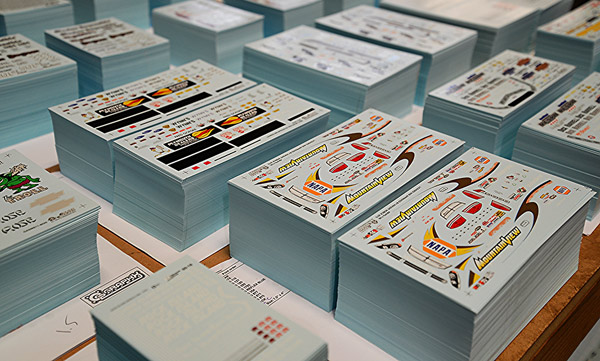
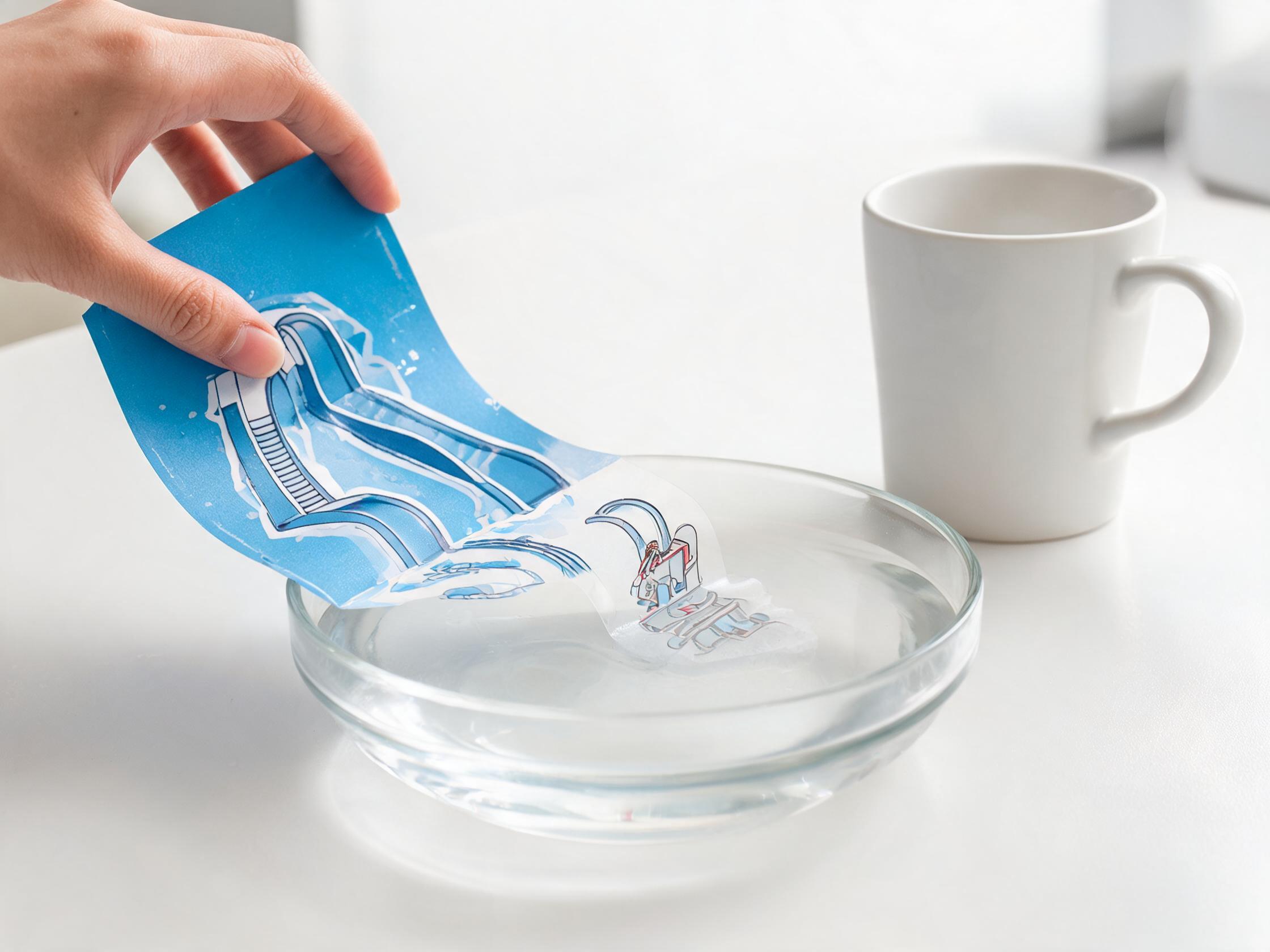
A water slide decal is a thin, printed design carried on water-activated backing paper. When the sheet is soaked in water, the printed film releases from the paper and can be slid, still wet, onto a smooth surface such as a ceramic mug, glass bottle or scale model body. Once positioned and dried, the decal is sealed with a clear coat or permanently fired in a kiln.
The name describes the process: water releases the decal, and the wet film slides into place. The same product is also called a water slide transfer, water transfer decal or water mount decal, and it has been the standard decoration method for ceramics and scale models for decades.
How a water slide decal works
A water slide decal sheet is built from four layers:
- Backing paper - a heavyweight paper carrier that holds everything flat during printing and storage.
- Water-soluble release layer - traditionally dextrose (a sugar), which dissolves on contact with water and frees the film.
- Printed ink layer - the artwork itself, printed by screen, offset or digital processes.
- Clear carrier varnish - a flexible transparent coat that holds the ink together while the decal slides and conforms to the surface.
Application takes under a minute: cut the decal out, soak it in room-temperature water for 20-30 seconds until the film starts to move, slide it onto the substrate, then smooth out any water and air bubbles with a soft squeegee. A full walkthrough, including how to avoid the silvering effect caused by trapped air, is in our water slide application guide.
Water slide decals vs other decal types
Water slide is one of three common decal families:
- Water slide decals release with water and leave an extremely thin film with no visible edge after clear-coating - the preferred choice for scale models, ceramics and glass.
- Vinyl stickers are self-adhesive and thicker; they apply dry in seconds, but the film edge stays visible and they survive neither kiln firing nor dishwasher cycles. We compare them in detail in water slide decals vs vinyl stickers.
- Dry transfer (rub-down) decals transfer by pressure instead of water, which suits small text and dry workflows but offers less repositioning freedom on curved surfaces.
Clear base vs white base
Water slide decals come on clear or white-backed film. Clear film lets the surface colour show through, so it suits light or white substrates. White-backed film carries an opaque white layer under the artwork, which keeps colours accurate on dark, transparent or coloured surfaces. Choosing the wrong base is the most common beginner mistake - our clear vs white base comparison shows both side by side.
Where water slide decals are used
Because the film is thin and conforms tightly to curves, water slide decals appear in more places than most people realise:
- Drinkware and tableware - logos and artwork on mugs, plates and bottles, fired onto the glaze for permanent, food-safe decoration such as our custom ceramic mug decals.
- Scale models - racing liveries, instrument dials and markings on 1:64, 1:43, 1:24 and 1:18 kits; see our model car decals range.
- Guitars and instruments - headstock logos applied under the lacquer.
- Candles, glass and home fragrance packaging - branding on smooth vessels.
- Electronics and appliances - dial markings and panel legends.
- Nail art and temporary tattoos - small-format water slide graphics.
How water slide decals are printed
Three printing technologies dominate production, each with a different cost and quality profile:
- Screen printing - thick, opaque ink layers and true spot colours including white and metallics; the standard for ceramic and model decals.
- Offset printing - very fine detail and smooth gradients at high volumes.
- Digital printing - no plates, so small runs and sampling are economical, and modern digital presses also print opaque white. The trade-offs are covered in digital vs offset printing for custom decals.
Hobbyists can also print their own decals on a desktop printer using water slide decal paper, which carries the same release system in an inkjet- or laser-compatible sheet.
Frequently Asked Questions
Are water slide decals permanent?
After application the film needs protection. On models and hard goods it is sealed with clear lacquer, which makes it effectively permanent for display and handling. On ceramics it is fired at 780-830°C, which fuses the decoration into the glaze permanently and makes it dishwasher and microwave safe.
Do water slide decals need water every time?
Yes - water is what dissolves the release layer and lets the film slide. Soaking for longer than 30 seconds rarely helps; if the film does not release, the water is too cold or the sheet is too old.
Can any surface take a water slide decal?
Any smooth, non-porous surface works: glazed ceramics, glass, painted or clear-coated metal and plastic, and lacquered wood. Bare porous surfaces such as raw wood or unglazed bisque need a sealed or painted finish first.
What is the difference between a decal and a sticker?
Everyday stickers are self-adhesive and apply dry. A water slide decal is a printed film transferred with water, which leaves a much thinner, paint-like result that can be lacquered or fired - it behaves like decoration rather than a label.
Have a surface or product in mind? Tell us what you want to decorate and we will recommend the right decal type, base and finish for your application.